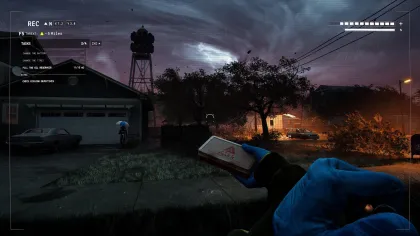
I picked up Funnel Runners the same week Supernova Studios announced they'd crossed 100,000 copies sold, mostly because a friend sent me a clip of a building visibly shedding its own roof mid-round and I needed to know if that was scripted or actually happening live. It's live. I set aside a weekend to run it properly with a rotating group of three to four people, logging what changed and what didn't from the first chaotic escape to the point, a few runs later, where the game's current limits started showing through the storm.
Run One: Learning That the Van Doesn't Care About Your Feelings
Nobody in my group had touched the game before, so the first run was less a survival attempt and more four adults wandering a suburb figuring out which house had a fuel canister in it. The van wouldn't start, which we knew going in, but nothing quite prepares you for how many separate things can be wrong with it at once until you're standing next to it holding a tire while someone else yells that the battery is somewhere across the map.
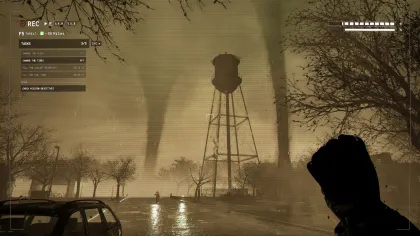
We heard the storm before we saw it — a low, building sound that I genuinely mistook for wind ambience until a teammate pointed out the dust already lifting off the street two blocks away. We lost that run. Not dramatically, just slowly, the way you lose a group project when nobody agreed on who was doing what — by the time we'd located half the parts, the tornado had already swallowed the block holding the other half, and watching a house we'd planned to loot get torn apart in real time was somehow more deflating than any death animation could have been.
What stuck with me from that first failure wasn't frustration so much as respect — most survival games let a bad run fade out quietly, a health bar ticking to zero somewhere off camera, but losing to a storm that visibly, audibly dismantles the exact resources you needed felt like getting outplayed by the environment itself rather than just running out the clock. We sat in the post-round lobby for a minute just talking about which building we should have hit first, which is not a conversation I expected to have after a single opening loss in a fifteen-dollar Early Access game.
Run Two: Actually Dividing the Work
The second run went better almost entirely because we stopped improvising and split up on purpose before the round even started — two people scouting for parts, two people staying near the van to start whatever repairs were already possible. That's when the full list of what the van actually needs clicked into place for me, since a run rarely asks for all of it at once but you never know in advance which pieces you'll be missing:
- Coolant, for overheating
- Motor oil, for a separate mechanical fault
- Fuel, since an empty tank strands a fully repaired van just as badly as a broken one
- Fuses, for electrical failures
- A spare tire, when a flat blocks movement outright
- A battery, the single most common point of failure across every run we played
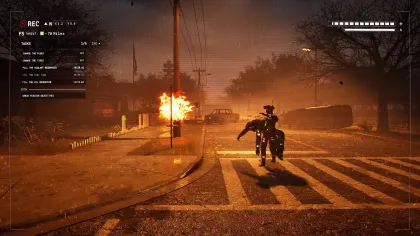
Carrying any one of those slows you down noticeably, and I learned that the hard way by trying to haul a tire and a fuel canister at once across an open street just as the storm's outer bands started tearing at the block behind me — I made it, barely, moving at what felt like half speed the entire way, and it was the first moment the game actually scared me rather than just impressing me.
It also settled an argument we'd been having between rounds about whether carrying two items at once was ever worth the speed penalty — the honest answer turned out to be situational rather than universal, since it saved us an entire extra crossing under storm pressure but would have been a needless risk on a run with more time to spare, and figuring that out ourselves rather than being told by a tutorial prompt is exactly the kind of thing that made the second run feel like actual improvement instead of just luck.
Run Three: The Storm Finally Got Personal
By the third run we'd gotten fast enough at splitting tasks that we had time to actually watch the tornado instead of just running from it, and that's when the destruction modeling really sold me — buildings groan and shed debris well before the funnel itself arrives, lights flicker as the local grid visibly fails, and the rotation above the visible funnel reads as something closer to an actual weather simulation than a horror-game special effect.
We escaped that run with seconds to spare, and I mean that literally — the van started, someone was still latching the door as we peeled out, and the house we'd pulled our last battery from was gone maybe ninety seconds later. It's the only time all weekend the whole group went quiet afterward instead of immediately queuing into the next round.
Run Four: Where the Cracks Started Showing
Two of my group had to drop for the night, so I queued into a fourth run solo, mostly out of curiosity about whether the game held up without a team to split tasks across. It didn't, not really — solo play feels less like a harder version of the same game and more like the game assuming a coordination structure that simply isn't there when it's just you, and I spent most of the run backtracking across the map alone rather than facing any interesting new challenge.
Midway through, I also got physically stuck under the map geometry near a collapsed section of a house, which cost me almost two full minutes of a timer I didn't have to spare, and there's no in-game way to report or flag that kind of bug beyond alt-tabbing out to a forum, which is a small thing on its own but adds up fast when you're already down a person and racing a clock that doesn't pause for a collision glitch.
None of that ruined the run so much as it made obvious what reviewers have been saying since the Early Access launch on July 16, 2026: this is one map, three layout variations, and one core objective, and a solo run in particular starts exposing how thin that content actually is once the novelty of the storm itself wears off slightly.
Run Five: Worth It Anyway
My group reassembled for a fifth and final run before the weekend ended, and going back in with a full team after the solo run reminded me why the game had hooked us in the first place — the tornado is still the best-looking, best-sounding thing about it, and coordinating four people around it is still genuinely tense in a way a lot of co-op games only pretend to be. Supernova Studios has been shipping patches daily since launch and has been explicit that they're not planning any paid DLC during roughly a year of promised Early Access content, including new biomes and modes beyond the current suburb.
At $14.99, with the studio's own statements pointing to a price increase once the game leaves Early Access, buying in now is also just the cheapest this game will ever be. I closed out the weekend with a positive read overall, tempered by knowing exactly what I was buying: an excellent, genuinely dread-inducing core mechanic wrapped around a content shell that's going to need those promised updates to actually arrive before the repetition Run Four exposed becomes the bigger story.
I also caught myself thinking back to the studio's own 100,000-copies announcement, which read less like a corporate milestone post and more like a genuine thank-you to a community that showed up faster than a small team was ready for — and after five runs, that framing tracks with what I actually experienced: a game that's clearly still catching its breath after its own launch, built around a mechanic good enough that I'm willing to wait out the growing pains rather than write it off because of them.
A full weekend with Funnel Runners confirmed the tornado simulation is the real draw — destruction that escalates convincingly and directly shrinks the resources available to a team racing against it. Co-op coordination is where the game shines, while solo play and a single map with one core objective are where its current Early Access limits show clearest, alongside real technical rough edges like map-geometry glitches with no in-game reporting tool.